
(a) About the Standards and Criteria
What are the Standards of Proficiency and the Criteria for Education and Training Programmes?
The Psychologists Registration Board has set what is known its pre-registration education and training requirements for entry onto its registers for clinical, counselling and educational psychologists. These are the requirements that education providers use to design their programmes against to ensure they deliver on the threshold regulatory requirements. The requirements comprise two key documents:
- The Standards of Proficiency outline the threshold knowledge, skills and professional behaviours required for entry onto a professional register. Education providers must ensure through the curriculum design and assessment that its programme ensures students who complete the programme have achieved all the Standards.
- The Criteria for Education and Training Programmes describe the processes and mechanisms that education providers must have in place to ensure each student who completes the education and training programme has demonstrated achievement of all the Standards.
Copies of the Board’s Standards and Criteria for clinical, counselling and educational psychologists are available on the CORU website here
What is the difference between Standards of Proficiency and Standards of Practice?
The Board is currently progressing work on drafting its Standards and Criteria for entry to its fourth register: the Psychologists Register. It is anticipated that the Board will be in a position to launch its public consultation process on its draft documents in October 2026
The Standards of Proficiency set the threshold knowledge and skills that an individual must have on day one of their practice in order to be able to enter onto the register.
In setting the threshold knowledge and skills, each Registration Board recognises that proficiency to practice a profession can be described on a continuum. The threshold represents the point on this continuum that is the minimum level of proficiency for safe and effective practice.
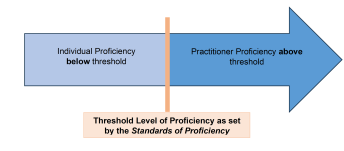
For every professional, their knowledge and skill evolve over time and will change through their experience, engagement in continuing professional development, additional post-qualifying training. This means that the Standards of Proficiency set by the Board may not fully reflect how an existing practitioner sees his or her current practice.
This is because the Standards of Proficiency articulate what is needed for entry onto the registers; what a practitioner must be able to do on day one of working as a clinical, counselling or educational psychologist.
It is also useful to highlight what the Standards of Proficiency are not. They are not Standards of Practice.
Standards of Practice set the minimum acceptable levels of performance that a registered professional must meet in the delivery of services and care. These are set out in the Code of Professional Conduct and Ethics.
Each Registration Board sets a Code that articulates the standards of conduct, performance and ethics which each member of the profession must adhere to throughout the course of his or her work. The Psychologists Registration Board will, in advance of the opening of its registers, publish the Codes of Professional Conduct and Ethics for each of its registers. A public consultation process on the Board’s draft Code, that sought feedback from all members of the profession, was conducted between 04 February and 04 March 2025.
Finally, it is important to stress that the Standards of Proficiency will be used to determine eligibility for registration for new graduates (when the registers open) from approved education and training programmes and used to assess international qualified applicants seeking to practice in Ireland. The Standards of Proficiency do not apply to existing practitioners who will make their registration application through the grandparenting provision (Section 91 registration pathway). There are separate requirements for this registration pathway which are explained in the FAQ – Introduction to the Registration Process section, along with other questions on the registration process.
What are the Standards and Criteria used for?
The Standards of Proficiency articulate the threshold knowledge, skills and professional behaviours required of an individual seeking entry onto a register. They are used across a number of regulatory functions, including:
- Approval and Monitoring of Education and Training Programmes: education providers that prepare students to practise a profession upon graduation – and who seek approval from the Board – use the standards to design their education and training programmes. Upon completion of an approved education and training programme, all graduates must have demonstrated achievement of all the standards.
- Approval and Monitoring of Education and Training Programmes: education providers that prepare students to practise a profession upon graduation – and who seek approval from the Board – use the standards to design their education and training programmes. Upon completion of an approved education and training programme, all graduates must have demonstrated achievement of all the standards.
The Criteria for Education and Training Programmes set the Board’s requirements around how an education and training programme seeking approval from the Board is designed and managed. The Criteria is used as part of the approval and monitoring of education and training programmes to ensure a programme has a system in place to consistently and effectively produce graduates who meet the Standards of Proficiency.
How did the Board set its Standards of Proficiency for clinical, counselling and educational psychologists?
The Health and Social Care Professionals Council set what are known as Framework Documents. These detail the knowledge and skills that are common across all professions CORU regulates. Each Registration Board adopts the Framework set by the Council and is then able to tailor it to meet the requirements of each profession, ensuring that the standards set in the profession-specific domain (Domain 5: Professional Knowledge and Skills) reflect the identity and practice of the profession at threshold entry into practice.
The Psychologists Registration Board, therefore, adopted Council’s Framework Standards of Proficiency and its common standards in Domains 1 – 4 and the first eight standards in Domain 5 and then undertook a detailed scoping and review exercise, reviewing existing accreditation standards in Ireland across the three specialisms of clinical, counselling and educational psychologists in order to draft profession-specific standards for Domain 5. To this analysis, the Board examined comparator entry level standards of proficiency used internationally. The Board undertook this detailed scoping work with the aim of identifying the threshold requirements for entry into practice of the three specialisms internationally in order to evaluate this against the current practice in Ireland to ensure that the work of the Board was reflective of both international best practice and of practice in Ireland.
As part of its work, the Board considered the following:
- Psychology Society of Ireland: Standards for the Assessment of Postgraduate Professional Courses in Clinical Psychology, last reviewed 2021
- Psychology Society of Ireland: Standards for the Assessment of Postgraduate Professional Programmes in Counselling Psychology, last reviewed 2013
- Psychology Society of Ireland: Accreditation Standards for Professional Doctoral Training in Educational Psychology in Ireland, last reviewed 2022
- Psychology Board, Ahpra (Australia): Professional Competencies for Psychologists, initially reviewed draft consultation document, February 2023 before reviewing the finalised published Professional Competencies, August 2024
- Psychology Board, Ahpra (Australia): Guidance on Area of Practice Endorsements, reviewed December 2019
- New Zealand Psychologists Board: Core Competencies for the Practice of Psychology in Aotearoa New Zealand, reviewed February 2018
- Health and Care Professions Council (UK): Standards of Proficiency for Practitioner Psychologists, reviewed September 2023
- International Association of Applied Psychology: Declaration on Core Competences in Professional Psychology, last reviewed June 2016
- Australian Psychology Accreditation Council: Accreditation Standards for Psychology Programs, last reviewed January 2019
- EuroPsy – The European Certificate in Psychology: Primary and Enabling Competencies, reviewed July 2023
- College of Psychologists of Ontario: Core Competencies required for the professional practice of Psychology, reviewed April 2019
In exploring how threshold standards for entry into practice were set, the Board focused on:
- identifying the knowledge and skills required at the entry point into practice – i.e. day one for a new graduate following successful completion of an education and training programme;
- the distinctions in the knowledge and skills required at the entry point into practice between the three specialisms;
- the distinctions between threshold entry standards and standards of practice, recognising the examination of some Standards of Practice documents;
- trends in international standards and how these compared to the practice of the professions in Ireland; and
- the articulation of standards to ensure understandability and clarity of the intended outcome.
In addition, consideration was also taken of the 2021 draft Standards of Proficiency for Psychologists and the feedback provided by stakeholders as part of that consultation process.
The Board prepared draft Standards of Proficiency for the three specialisms and published them for feedback as part of a public stakeholder consultation process conducted between 7 October 2024 and 30 November 2024. On the basis of the feedback received, the Board reviewed and revised its draft Standards for each of the specialisms.
The Standards of Proficiency published here are the product of this extensive development process.What is the minimum level of qualification (NFQ Level) programmes for clinical, counselling and educational psychology must be designed to?
The Board’s Criteria for Education and Training Programmes for clinical, counselling and educational psychologists outline the quality assurance requirements that education and training programmes must follow to ensure all graduates demonstrate achievement of the Standards of Proficiency. The threshold level of qualification for entry onto the register (criterion 1.1) must align with the requirements set out in the Board’s Standards of Proficiency.
The Board has set the threshold level of qualification for entry into practice for each specialism as follows:
|
Profession |
Threshold Level of Qualification |
|
Clinical Psychologists |
Level 10 |
|
Counselling Psychologists |
Level 10 |
|
Educational Psychologists |
Level 10 |
How did the Board determine the threshold qualification level for entry to the clinical, counselling and educational registers?
Following the post-consultation review and revision of its Standards of Proficiency across the three specialisms and following detailed consideration of the feedback received from stakeholders during the consultation process, the Board concluded that the threshold level for entry into practice for the specialisms of clinical, counselling and educational psychology was at Level 10 on the National Framework of Qualifications.
The Board undertook a two-fold process in order to determine the threshold level of qualification:
- Step One: a substantive review of the articulation and content of each individual standard, considering the threshold level outcomes required and the associated higher order skills and the level or demand of the specific area of knowledge or skill required in order to demonstrate achievement of these outcomes; followed by
- Step Two: using this understanding to reach a determination of the holistic level of demand required by the Standards of Proficiency to map this against the National Framework of Qualifications Level Descriptors that set the broad indicators of knowledge, skill and competence required for attainment of a qualification at each level of the National Framework of Qualifications in Ireland.
Noting its responsibility under the principles of right-touch regulation and its legislative requirement to ensure proportionality in the regulations introduced, - in line with the EU Directive on Proportionality - the Board acknowledged that threshold level into practice across Europe is set at Masters Level (NFQ Level 9). However, its review of the education and training pathways across the European Union concluded that there is not a single qualification at this level that provides a pathway into practice. Rather, entry into autonomous practice requires the completion of a Masters level academic qualification that is combined with either an additional qualification in the psychology specialism or a period of assessed professional practice. . As such, entry into practice of each of the specialisms of clinical, counselling and educational psychology in other European jurisdictions requires the completion of further training components that assess proficiency and readiness for autonomous practice in addition to completion of a single Masters level qualification. In addition, the Board noted that model of professional doctorates that offer a singular postgraduate training pathway into practice for clinical, counselling and educational psychology are not available in other European countries.
What will the hours requirement for practice placement be for education and training programmes in clinical, counselling and educational psychology?
As part of its Criteria for Education and Training Programmes for clinical, counselling and educational psychologists , under criterion 2.2, the Registration Board has stipulated that students must complete a minimum number of hours in practice education as part of their education and training.
The requirements for each profession have been articulated as follows:
|
Clinical Psychologists |
The programme must ensure that each student completes a minimum of 240 days in practice placement.
|
|
Counselling Psychologists
|
The programme must ensure that each student completes a minimum of 240 days in practice placement.
|
|
Educational Psychologists
|
The programme must ensure that each student completes a minimum of 240 days in practice placement.
|
Why did the Board determine the same number of threshold placement days for clinical, counselling and educational psychology education programmes?
When preparing its draft Criteria for Education and Training Programmes for public consultation, the Board, while recognising that among the current design of education and training programmes there were different placement days threshold, reaffirmed the relationship between its Standards of Proficiency and Criteria; namely, that any profession-specific requirement set in the Criteria must be founded in the achievement of all the Standards.
To this end, having assessed the substantive content of the draft Standards and determining the demand required of students – in terms of the knowledge and skills required for entry into practice – across the three specialisms was comparable, the Board concluded that the same minimum number of placement days were required to deliver on achievement of all the Standards. Across the three specialisms, the Board agreed that the threshold number of days for practice education was 240 days.
As part of the consultation process, a number of stakeholders submitted feedback suggesting that there should be a different number of minimum placement days across the three specialisms.
The Board, while noting the feedback provided, reaffirmed that the basis upon which it could take a decision around practice placement requirements was a review of the Standards of Proficiency. Recognising that the Standards across all three specialisms had been revised in light of feedback from stakeholders, the Board reviewed these revised standards to determine whether the level of demand required of students was comparable across the three specialisms and concluded that it was. As a result, having determined that there was no change in demand across the three specialisms, the Board confirmed that each of the three specialisms should require the same number of minimum practice placement days.
In setting the same number of placement days across the three specialisms, the Board emphasised that this was the minimum number of practice education days that each student must complete and that education providers had flexibility in designing education and training programmes to require more than 240 days. Additionally, the Board emphasised that while the Criteria is used to support the achievement of the Standards, it is the demonstration that an individual has achieved all the standards of proficiency that provides the metric against which eligibility for entry to the register – and by extension, into practice – and, thereby, the assurance of public protection. It is not the minimum number of placement days that offers regulatory assurance of proficiency but the demonstration of achievement of all the Standards.
How did the Board determine the minimum number of practice placement days for education and training programmes in clinical, counselling and educational psychology?
The requirements set out in the Criteria for Education and Training Programmes are concerned with providing assurance that an education and training programme has the necessary processes and mechanisms in place to ensure that each student completing the programme – and, ultimately, holding the associated qualification – has demonstrated achievement of the Standards of Proficiency. Therefore, any requirement set in the Criteria must be founded in the achievement of all the Standards.
In setting the minimum number of days of practice placement then, the Board assessed and reviewed its revised Standards of Proficiency. Having reviewed the content of the standards holistically, alongside the level of demand required to demonstrate achievement of the skills-based proficiencies articulated, the Board concluded that the minimum number of days required to demonstrate achievement of the Standards was 240 days. In line with its assessment, as detailed in the preceding question, the Board agreed that the same number of days was required across the three specialisms of clinical, counselling and educational psychology.
In setting this minimum number of placement days the Board emphasised that this was the minimum number of practice education days that each student must complete and that education providers had flexibility in designing education and training programmes to require more than 240 days. Additionally, the Board emphasised that while the Criteria is used to support the achievement of the Standards, it is the demonstration that an individual has achieved all the standards of proficiency that provides the metric against which eligibility for entry to the register – and by extension, into practice – and, thereby, the assurance of public protection. It is not the minimum number of placement days that offers regulatory assurance of proficiency but the demonstration of achievement of all the Standards.
The Board reviewed and considered the total number of placement days currently required on education and training programmes across the three specialisms. It noted, as well, the relationship between the funding support received to facilitate the current practice placement arrangements. As part of its decision-making process, the Board affirmed that it was not able to consider the current provision of financial support to programmes; the only metric the Board has available to it in determining the minimum number of placement days is its Standards of Proficiency.Why did the Board make changes to criterion 2.2 in the Criteria for clinical, counselling and educational psychologists from the draft published for consultation?
As part of its draft Criterion 2.2, published as part of the public stakeholder consultation process, the Board had proposed caveats that prescribed specific requirements around the delivery of practice education during an education and training programme. The intention of the Board in proposing these caveats was to ensure that programmes provided the necessary breadth of exposure to practice of the specialism during an individual’s education and training to ensure safety to practice upon entry to the register.
The feedback received from stakeholders on these proposed caveats raised a number of issues:
- principally, there was widespread misinterpretation that the articulation of service user groupings was referencing specific service settings or environments within one particular employment setting where practice education should be undertaken. This was not the original intention of the Board in articulating such service user groupings; and
- additionally, there was substantial fragmentation between and within the three specialisms regarding differing definitions of service user groupings, and, perhaps most fundamentally, differing perceptions around areas of work and scope of practice, including definitional challenges around the meaning of particular terms – for example, disability.
In addition, the Board also reflected on potential longer term, future risks of the inclusion of service user groupings in its Criteria. Most notably, it was articulated that the current identification of service user groupings is on the basis of current service delivery models. As has been the case over the course of the past decade, the delivery of psychological services has changed. The concern was noted that if the Criteria stated service user groupings as they are expressed within one employment setting at present, there was no flexibility within this requirement that would facilitate the dynamism and change of service provision into the future.
In reviewing the consultation feedback received and considering the issues presented by it in relation to the addition of caveats to criterion 2.2, the Board returned to two key issues:
- firstly, it reviewed its revised Standards of Proficiency for the three specialisms; and
- secondly, it considered criterion 2.2 within the context of the broader suite of requirements in Criterion Two of its Criteria around provisions for practice placement.
Within its revised Standards, it concluded that the breadth of service user experience required for safe practice was articulated in the knowledge and skills proficiencies that all students are required to demonstrate achievement of.
Furthermore, it agreed that criterion 2.2 does not sit in isolation. It works with all the other placement criteria to offer regulatory assurance. With regard to the original intention of the Board – specifically, that programmes provide the necessary breadth of exposure to practice of the profession during an individual’s education and training to ensure safety to practice upon entry to the register – criterion 2.3 was highlighted:
Criterion 2.3: The number, duration and range of practice placements, and their position within the programme must reflect current practice and demands of the profession. They must be appropriate to facilitate translation of theory into practice and the achievement of the standards of proficiency.
The Board agreed that the element contained within this criterion – that practice placements must reflect the current practice and demands of the profession – provided the necessary regulatory assurance to deliver on its objective: the exposure, during practice education, to practice of the profession that will prepare graduates to enter safely into practice with a range of service user groupings and in the settings within which this practice is undertaken.
The Board concluded that the regulatory assurance provided by its revised Standards of Proficiency combined with the application of criterion 2.3 within the programme approval process did not require the additional inclusion of caveats to criterion 2.2. It was for this reason the Board agreed to make changes to its draft criterion 2.2 and concluded that it would not include any caveats to its articulation of its finalised criterion 2.2.
The Criteria for Education and Training Programmes requires that educators responsible for delivery and assessment of the core professional elements of the programme must be registered with the appropriate registration board.
In establishing a qualifications-based register, as required under the Health and Social Care Professionals Act 2005 (as amended), the Psychologists Registration Board will approve education and training programmes that provide direct entry into practice of the profession. Currently, the structure of education and training of psychologists in Ireland means that undergraduate psychology programmes do not provide a direct pathway into practice. As such, undergraduate psychology programmes will not be subject to approval by the Psychologists Registration Board. Therefore, educators on undergraduate programmes will not be required to register with the Psychologists Registration Board as part of their work on those programmes.
Education and training programmes that provide direct entry into practice of the profession and that make an application for approval by the Registration Board will be subject to Board’s Criteria for Education and Training Programmes. This means that any educator involved in the delivery of the core professional elements of the programme must be registered with the Board. This does not mean that every individual teaching on the programme must be registered. For example, the topic of child protection is not specific or particular to the practice of psychology. It would not be considered a core professional element of the programme. Therefore, an individual who teaches on the topic of child protection would not be required to be registered with the Psychologists Registration Board. In contrast, those who are involved in the teaching and assessing of the core theory and practice of psychology will be required to be registered with the Board.
The draft Standards of Proficiency for Psychologists look differently when compared with the Board’s standards for clinical, counselling and educational psychologists in two respects:
- How the standards are articulated; and
- The Framework Standards of Proficiency adopted.
[1] How the Standards are articulated
Reflective of the objective of the Psychologists Register to accommodate multiple and different areas of psychology practice, the Psychologists Registration Board has prepared draft threshold standards for entry to this register that allow for flexibility in their application across the range of psychology specialisms.
Adopting what are known as principles-based standards of proficiency, this type of regulatory standard does not prescribe detailed instructions to be followed, but sets out broadly defined principles that describe the intended outcome. The shift in focus is moving from describing how something should be done to articulating what knowledge or skill is to be achieved. This approach recognises that there are multiple ways to achieve a standard and, therefore, allows for greater flexibility is provided in how this achievement can be demonstrated.
For example, while both sports and exercise psychologists and health psychologists are involved in developing interventions, how this skill is demonstrated will be different to the practice of both specialisms. A principles-based approach to setting standards allows the Board to set a common threshold standard but provides for specialism-specific application.
[2] Framework Standards
As a multi-profession regulator, CORU currently has responsibility for 12 health and social care professions. While each of these professions have their own distinct character, there are areas of commonality across all these professions. Reflecting this, the Health and Social Care Professionals Council establishes what is known as the Framework Standards of Proficiency. This Framework details the shared proficiencies across each of the different health and social care professions CORU regulates.
Each registration board adopts Council’s Framework Standards of Proficiency, which are articulated in the first four domains of the Standards of Proficiency document. The board is then able to add profession-specific proficiencies to Domain Five.
Council reviews its Framework Standards on a cyclical basis. Its most recent review was completed in January 2025. This review was completed after the Psychologists Registration Board had commenced work on setting its Standards for its first three registers. As such, the Standards that the board published for these three registers use the previous version of Council’s Framework. By the time the board commenced work in drafting its Standards for the Psychologists Register, Council’s revised Framework had been agreed and set.
|
In preparing its draft Standards, the Board was informed by international regulatory and psychology expertise from Australia and Europe, along with psychology and education quality assurance and regulatory expertise from Ireland. At the start of the drafting process, a number of guiding drafting principles were agreed. This meant that each standard that was drafted was tested against these principles:
Having established these guiding principles, there were a number of stages of comprehensive mapping of international regulatory standards and current national professional body accreditation standards that informed the content of the draft standards. To this end, the following were examined: In undertaking the mapping process, three key issues were considered: On the basis of this extensive drafting process, the Board prepared its draft Standards of Proficiency for public consultation. |
The Board’s draft Criteria for Education and Training Programmes outline the quality assurance requirements that education and training programmes must follow to ensure all graduates demonstrate achievement of the Standards of Proficiency. The threshold level of qualification for entry onto the register (criterion 1.1) must align with the requirements set out in the Board’s Standards of Proficiency.
The Board is proposing to set the threshold level of qualification for entry to the Psychologists Register at NFQ Level 9 and set the class of qualification as a Major Award.
|
When setting its Criteria, each registration board articulates the profession-specific level of exposure to practice placement that is required during the course of an education programme. There are different ways that this can be expressed. When setting its Criteria for clinical, counselling and educational psychologists, the board – in assessing its threshold standards – used the metric of a minimum number of days exposure to practice of the specialism. When considering the threshold exposure to practice placement in the context of the Psychologists Register, the Board reflected on the application of its draft requirements across multiple and different psychology specialisms. In particular, the Board noted that its draft Standards of Proficiency are articulated flexibly, at a principles-based level, in order to accommodate application across multiple different specialisms, where their application will likely be different depending on the psychological service offered and the environments of engagement with service users. Therefore, the Board concluded that exposure to practice placement in its Criteria should reflect this principle of adaptability that allows for application depending on the nature of the specialism, while ensuring achievement of the Standards of Proficiency. The Board recognised that given the different application of the Standards appropriate to each specialism, some areas of psychological practice may require more exposure |
The setting of the threshold qualification level is directly related to the achievement of the Standards of Proficiency. Therefore, the Board first prepared its draft Standards of Proficiency before then, on the basis of the Standards, determined the threshold qualification level.
In proposing its threshold qualification level for entry to the Psychologists Register, the Board examined undertook a two-step process:
In order to reach its proposal, the Board examined and considered: