
- About Us
- Members of the Psychologists Registration Board
- About the Psychologists Registration Board
- Psychologists Registration Board Member Biographies
- Update on Statutory Regulation of Psychologists
- Regulation for Clinical, Counselling & Educational Psychologists
- Standards and Criteria for Clinical, Counselling and Educational Psychologists
- Psychologists Register
- FAQs
Update on Statutory Regulation of Psychologists
Update on regulation of psychologists (March 2026)
The Psychologists Registration Board continues to advance the introduction of statutory regulation for the psychology profession in Ireland. Working in close partnership with the Department of Health, the Board has developed a regulatory model that will protect the title psychologist through the establishment of four registers: one each for clinical, counselling and educational psychologists, and a fourth register for all other psychology specialisms. This model is designed to ensure clarity and consistency for the public, employers and practitioners.
Regulation will be introduced in two phases. The first phase will establish the registers for clinical, counselling and educational psychologists, with the second phase introducing the register for all other psychologists.
Significant preparatory work has already been completed to support the establishment of the first three registers. This includes the publication of the Standards of Proficiency and the Criteria for Education and Training Programmes for each register, the development of Continuing Professional Development (CPD) requirements, and substantial progress on finalising the Codes of Professional Conduct and Ethics following extensive consultation.
In parallel, the Board has been advancing work to develop Standards of Proficiency for entry to the psychologists register and, in 2025, began early engagement with education providers and practitioners on draft Standards ahead of a formal public consultation process. This proactive engagement ensures that the regulatory framework reflects current practice, supports high‑quality education and maintains a strong focus on public protection.
To ensure the new regulatory model is fully supported in legislation, a number of technical amendments to the Health and Social Care Professionals Act are required. CORU is working collaboratively with the Department of Health to progress these amendments, along with the remaining legislative and regulatory steps necessary to establish the registers for clinical, counselling and educational psychologists.
In light of this ongoing legislative process, the opening of the first three registers is now expected in 2027. CORU and the Department of Health remain committed to progressing this work as efficiently as possible, while ensuring that the regulatory framework is robust, transparent and aligned with statutory requirements.
CORU will continue to keep all stakeholders informed through our website, newsletter, social media channels and ongoing engagement with the professional body, relevant unions, employer organisations and other key stakeholders.
Background The Psychologists Registration Board was established in 2017 to regulate psychologists in Ireland. Its goal is to protect the public by introducing statutory regulation to the psychology profession. This will protect the title of psychologist meaning that only qualified people, who have registered with CORU can use that title.
The Board has developed an approach to regulate the profession effectively that will enable the protection of the title psychologist.
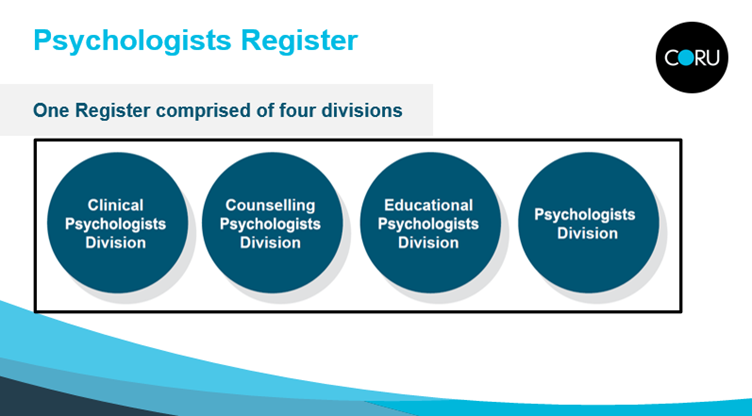
One Register, Four Divisions
Since its establishment, the Board has been developing a model that both protects the title psychologist and acknowledges that in Ireland, psychologists typically enter the profession through different specialist fields.
To address this, the Board conducted a detailed risk analysis, evaluating different areas of psychology based on the potential harm they could cause, the complexity of the work involved, and the readiness of education programs to meet regulatory standards.
Based on this analysis and public feedback from consultations the Board decided on a regulatory structure that includes one main register with four divisions: Clinical, Counselling, and Educational Psychologists, which are considered higher-risk areas, and a general division for all other psychologists.
This structure will ensure that all practising psychologists meet a consistent level of professional competence, while also protecting the public by safeguarding the use of the title psychologist.
Education and Training Requirements
To register, psychologists must meet specific education and training standards set by the Board, which ensure they have the necessary knowledge and skills for safe and effective practice.
The Board will also assess and approve education and training programmes to make sure they consistently produce graduates who meet these standards.
Each division - Clinical, Counselling, Educational, and the general Psychologists Division—will have its own set of pre-registration requirements, determining eligibility for registration. This process ensures that only those with approved qualifications can enter the profession.
Psychologists Division
The Psychologists Division will include the various psychology specialisations not covered by the Clinical, Counselling, or Educational divisions.
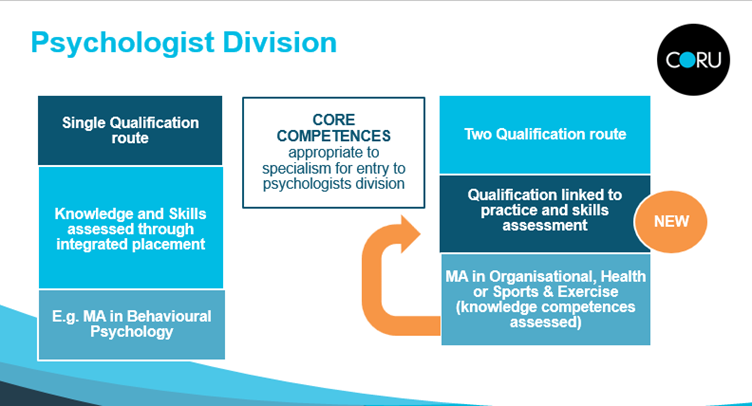
The Board will set core competencies - key knowledge, skills, and professional behaviours - that apply across all specialisations. These core competencies will be flexible, allowing the competences reflect the different fields of psychology, being applied ‘as appropriate to the specialism’.
Education programmes will need to meet these standards to be approved, ensuring they provide both academic learning and practical experience.
Education and Training Pathways The Board establishes a qualifications-based register, this means that new graduates in Ireland will need to hold a qualification approved by the Board to be added to the register once it opens.
There are separate registration processes for existing practitioners and for applicants with international qualifications.
Once the Board sets its education and training requirements for each division, it will work with education providers, giving them time to adjust their programmes to meet these standards. The Board will then assess these programmes and create a list of approved qualifications. Graduates with these qualifications can register in the appropriate division.
Pathways for Clinical, Counselling, and Educational Psychologists Divisions Currently, the education and training programmes for Clinical, Counselling, and Educational Psychology combine classroom learning with practical placements. This structure helps students gradually build the skills and knowledge needed for safe practice. The Board will evaluate these programmes to ensure they meet its standards before adding them to the list of approved qualifications.
Pathways for the Psychologists Division Recognising the variety of education and training routes for different psychology specialisations, the Psychologists Division will offer two qualification options:
- Single Qualification Route: Some psychology programmes already combine academic learning with practical training. The Board will review and approve these programmes, listing them as a pathway to registration.
- Two Qualification Route: For psychology specialisations that currently offer only academic learning, the Board allows for a second qualification focused on practical experience. Both the academic and practical qualifications must meet the Board’s standards to be approved as pathways to registration.
In both routes, the Board will assess all programmes against the same pre-registration education and training requirements to ensure they produce competent, safe practitioners.
Implementation Timelines Regulation will be rolled out in two phases: one for the specialisms of Clinical, Counselling, and Educational Psychologists, and one for the general division.
This is because the Board has determined that these specialisms, as well as being higher risk, are closer to being ready for regulation due to their preexisting education and training programmes.
The first phase to open three divisions of the register for clinical, counselling and educational psychologists is expected to begin in October 2025, while the general division could take 2 to 4 years to fully implement, depending on how quickly education providers adapt to the new qualification requirements.
Please also access our frequently seen questions for further details on the approach to regulating psychologists.